
When Wuthering Waves first emerged in May 2024, it arrived like a storm on the horizon, promising to shake the foundations of the open-world gacha genre that Genshin Impact had so thoroughly defined. A year later, in the spring of 2026, that storm has finally made landfall on Steam. Having previously been confined to its own dedicated launcher and the Epic Games Store, the game’s debut on Valve’s platform has unlocked a fresh audience, and the response has been immediate—like a long-sealed vault suddenly thrown open, thousands of players have flooded in to explore its shattered, futuristic landscapes.
Within hours of its Steam release, the concurrent player count surged past the ten-thousand mark, a figure that stabilized into a healthy, five-digit daily average as the weeks progressed. This is all the more remarkable given that Genshin Impact, the undisputed titan of the genre, remains absent from Steam. For millions of PC gamers who treat the platform as their primary gateway, Wuthering Waves fills a glaring void—a generous, free-to-play invitation into a world that feels both familiar and daringly distinct.
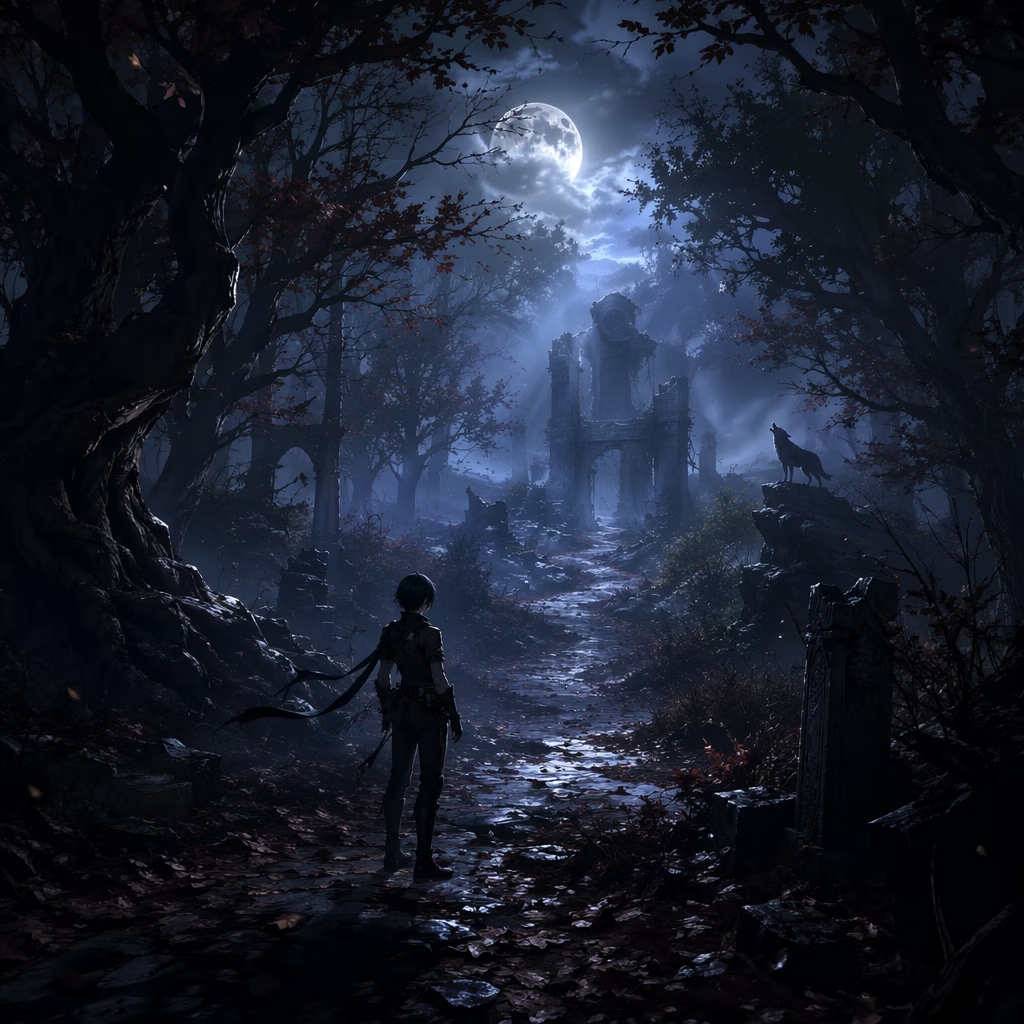
The narrative backdrop is a post-apocalyptic Earth, bleached of most of its humanity by a cataclysm known as the Lament. Survivors huddle in isolated pockets, and the player steps into the role of a Rover—an amnesiac traveler whose origin is as enigmatic as the world’s scars. Exploration is a slow-burn archaeology, each mission peeling back layers of memory and catastrophe. The game does not simply hand out its lore; it buries it beneath ruins and within the static-laced echoes of a fallen civilization. Players must dig for meaning like scholars uncovering a lost language, piecing together fragmentary records to understand what was lost.
Gacha mechanics form the spine of progression, of course. Characters and weapons are drawn from randomized banners, demanding patience or deep pockets. Login streaks, daily commissions, and resource grinds will feel like a second home to genre veterans. Yet Wuthering Waves distinguishes itself with a monster-catching system that functions as a clever twisting of expectations. Instead of equipping static artifacts or relics, players can absorb the echoes of defeated enemies—spectral remnants that confer passive bonuses and active abilities. Each enemy type leaves behind a unique Echo, and a character can equip several, essentially building a secondary skill loadout that reflects the creatures they have conquered.
This system turns every combat encounter into a potential treasure hunt. The desire to collect a full bestiary of abilities becomes an obsessive, low-grade hum in the background of every session. It is a loop that echoes the compulsive charm of a Pokédex marathon, but here the creatures are twisted aberrations born from the Lament, and the prize is not just completeness but a tangible edge in battle. Farming the perfect Echo with the ideal sub-stats can be as grueling as any traditional artifact chase, yet the visual and mechanical variety keeps the process fresher. One moment you might dart across a ravine using an Echo that grants a burst of spectral speed; the next, you could summon the rocky fist of a golem to shatter an enemy shield.
Combat itself is fluid and reactive, demanding precise dodges and parries that reward timing over brute force. Characters have distinct combat rhythms, and swapping between them mid-combo weaves a dance of elemental reactions and staggered stuns. The open world encourages this engagement with a traversal system that feels remarkably unshackled. Wall-running, mid-air grapples, and a stamina-free sprint outside of combat make navigation a joy rather than a chore—a constant, frictionless glide through a broken world.
For all its strengths, the game does not entirely escape the gravitational pull of its genre’s flaws. The grind for upgrade materials can settle in like a stubborn fog, particularly for those aiming to max out multiple teams. The story, while ambitious, occasionally stumbles under the weight of its own terminology, asking players to memorize a lexicon of resonant frequencies and tacet fields before the emotional stakes fully land. And while the Steam version brings technical improvements, including better frame pacing and customization options, it still demands a capable rig to render the sprawling vistas at their best.
Yet these are quibbles in the face of the game’s value. Wuthering Waves on Steam represents a matured version of a title that had already found its footing. The 2.3 update, which coincided with the Steam launch, introduced two new five-star characters—one a gravity-wielding swordsman who redefines aerial combat, the other a healer whose melody-based abilities turn survival into a rhythmic puzzle—alongside a new zone of floating islands tethered by shimmering energy bridges. The content cadence has held steady, and the developers have shown a willingness to rebalance older units, a practice that keeps the meta from stagnating into a rigid hierarchy.
Perhaps the most telling sign of the game’s warm reception is the quiet hum of its community. Steam forums buzz with Echo hunting tips, co-op invitation threads, and the inevitable debates over which character’s side story packed the harder emotional gut-punch. It is a living ecosystem that many believed only Genshin Impact could sustain on PC. That Wuthering Waves has carved out its own niche—not as a killer, but as a genuine peer—is a testament to its distinctive flavor.
At no cost, there is no barrier to step into this fractured world. For the lapsed player who drifted away during its launch year, the Steam version offers a perfect re-entry point. For the newcomer, it is a vast, generous, and visually arresting adventure that learns from its predecessor while daring to write its own scars across a world both dead and fiercely alive. The echo of a promise made two years ago has finally resonated across the platform where it belongs, and it sounds like a beginning, not an end.
0 Comments