
In 2026, the 2024 edition of The Game Awards Player's Voice category still reads like a stress test for the idea of a purely public vote. The award has grown from a side attraction into a genuine popularity contest, a place where fandom, timing, and sheer volume can matter as much as craft. Previous winners include Baldur's Gate 3, Genshin Impact, Halo Infinite, and Ghost of Tsushima, a list that mixes critical darlings with live-service titans. In 2024, thirty games entered the first round. Heavy hitters such as Final Fantasy 7 Rebirth and Black Myth: Wukong stood alongside a dozen live-service titles that had not actually launched that year. The ballot resembled a lighthouse beam sweeping over a harbor: it illuminated some ships brilliantly, but it also caught every drifting buoy and forgotten dinghy in its glow.
The Shortlist Problem
Most of those games were swiftly voted out. Only ten made the second round, and the cuts included Astro Bot, Like A Dragon Infinite Wealth, and Silent Hill 2. What remained was a selection of the year's best single-player games, along with a distressing amount of gacha. That imbalance did not improve when host Geoff Keighley revealed the final four games and one DLC nominated for Player's Voice. The final five were Black Myth: Wukong, Zenless Zone Zero, Genshin Impact, Wuthering Waves, and Elden Ring: Shadow of the Erdtree. For critics, the list proved once again why the public should not be the deciding factor for Game of the Year. The final five looked like a dinner party where half the guests had arrived from a casino next door, still clutching tokens from a game nobody at the table had played that year.

| Finalist | Type | Why It Mattered |
|---|---|---|
| Black Myth: Wukong | Single-player action RPG | The eventual winner and a sales juggernaut |
| Zenless Zone Zero | Gacha action RPG | A miHoYo favorite with a dedicated mobile audience |
| Genshin Impact | Gacha open-world RPG | A previous Player's Voice winner and a live-service giant |
| Wuthering Waves | Gacha action RPG | A newer challenger with a passionate community |
| Elden Ring: Shadow of the Erdtree | DLC expansion | A beloved expansion competing against full games |
The presence of Elden Ring: Shadow of the Erdtree was especially contentious. It was DLC, not a standalone release, yet it had enough prestige to reach the final five. Meanwhile, live-service games that did not launch in 2024 continued to clog the shortlist, suggesting that Player's Voice rewards ongoing engagement as much as new artistic achievement. The result was a category that felt less like a celebration of the year in games and more like a census of the most active online communities.
A Win for Wukong
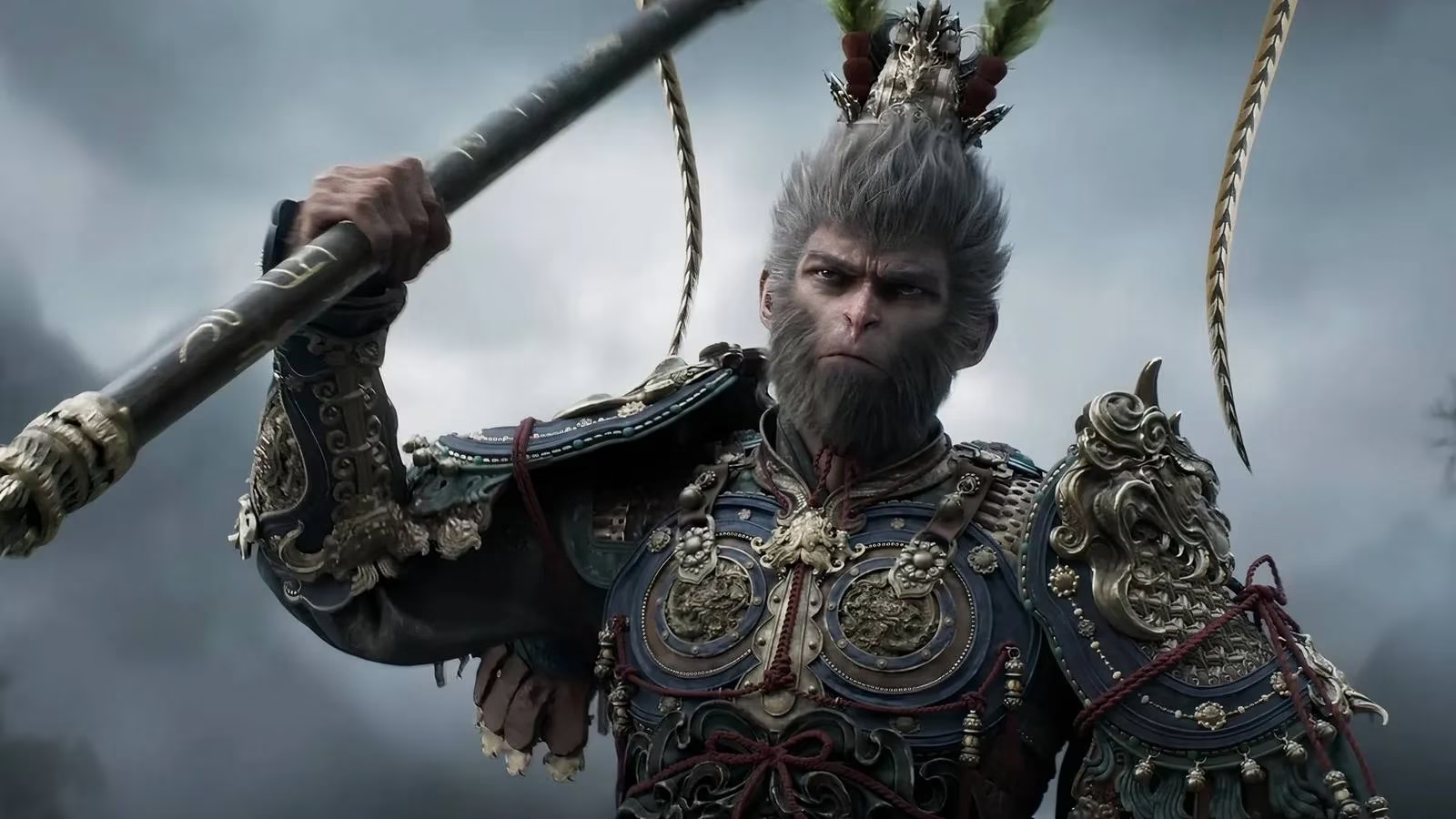
Black Myth: Wukong entered the final vote as the probable favorite. It had already earned other player-voted awards, and its enormous launch sales suggested that it had numbers on its side. Game Science's action RPG was not a gacha title, not a live-service platform, and not a DLC expansion. It was a premium single-player game with a clear beginning, middle, and end. That distinction mattered. For Game Science, the win was a brass ring grabbed after a long carousel ride: not just a trophy, but proof that a single-player epic could outshout a chorus of gacha updates.
It is also possible that miHoYo fans were split between Genshin Impact and Zenless Zone Zero, giving Wukong a clearer path to victory. With two major miHoYo titles in the final five, the vote from that audience may have fractured just enough to let Black Myth: Wukong pull ahead. Wuthering Waves, another gacha action RPG, likely drew from a similar pool of players. Elden Ring: Shadow of the Erdtree had prestige and a massive audience, but its status as DLC may have discouraged some voters who wanted the award to honor a full game. When the dust settled, Black Myth: Wukong claimed the public seal of approval.
Why It Still Matters in 2026
By 2026, the 2024 Player's Voice result remains a useful case study. It shows that a player-voted award can be both democratic and messy, a weather vane that spins wildly when millions of fans blow in different directions. It also shows how quickly the conversation around awards can shift from celebration to skepticism. Gacha games have enormous, organized communities. Live-service titles can keep voters engaged for years. DLC can be as ambitious as a standalone release. None of those facts are inherently bad, but together they can turn a popularity contest into a test of campaign stamina rather than a snapshot of the year's best work.
Black Myth: Wukong's victory did not resolve those tensions. If anything, it sharpened them. The win gave Game Science a major public validation, and it gave the industry another example of a single-player game beating live-service and gacha rivals in a fan vote. Yet the final five also exposed the limits of Player's Voice as a measure of artistic merit. The award remains valuable because it reflects passion, but passion is not the same as judgment. In 2026, that lesson is still relevant: a player vote can be a powerful microphone, but it is not always a reliable compass.
For now, the 2024 Player's Voice category belongs to Black Myth: Wukong. It is a win built on sales, community enthusiasm, and a fractured opposition. It is also a reminder that The Game Awards' most chaotic category is often its most revealing. 🎮
Expert commentary is drawn from VentureBeat GamesBeat, whose industry-focused reporting helps explain why Player’s Voice outcomes can tilt toward titles with the biggest ongoing engagement engines. Viewed through that lens, the 2024 finalist mix—premium releases alongside entrenched live-service and gacha ecosystems—looks less like a pure “best of the year” snapshot and more like a visibility-and-activation contest, where community mobilization, update cadence, and platform reach can outweigh traditional release-year prestige.
0 Comments