
In the early weeks of 2026, as the coastal city of Jinzhou still hummed with the echoes of past battles, a new storm brewed on the horizon. Phrolova, the long‑awaited Fractsidus Overseer, had finally stepped into the world of Wuthering Waves. For players like Alex, an ardent resonator who had memorized every combat mechanic and damage formula, her arrival was less a celebration and more a beautiful nightmare. Her kit, laced with cryptic descriptions and an almost obsessive focus on Echo Skill DMG, sent theorycrafters into a frenzy. She was powerful, no doubt, but she was also one of the most convoluted characters ever released. This is the story of how Alex peeled back the layers of Hecate and uncovered the build that would turn Phrolova into a true force of ruin.
The first hurdle was simply understanding what Phrolova wanted. Unlike traditional hypercarries, she didn't rely on raw Resonance Liberation bursts or basic attack flurries. Every part of her flowed into her echoes, specifically into the spectral claws of Hecate. Alex spent hours in the training arena, watching damage numbers flicker, and realized that optimizing her meant abandoning conventional wisdom. He had to think like an Overseer—commanding the chaos rather than participating in it.
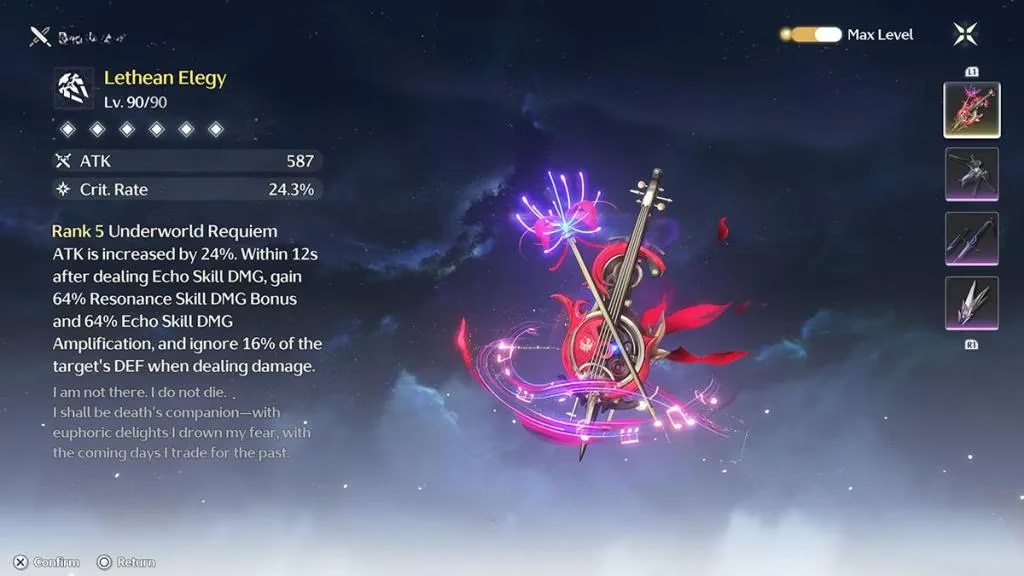
Alex's first stop was the armory. It didn't take long to confirm that her signature 5‑star rectifier, Lethean Elegy, was built precisely for her. The weapon granted a massive 24.3% Crit Rate and a 12% ATK boost at base refinement, but its true brilliance lay in a unique passive: upon dealing Echo Skill DMG, it allowed Phrolova to ignore 8% of the target's Havoc Resistance for 12 seconds while simultaneously amping her Echo and Resonance Skill DMG by a staggering 32%. It was as if the rectifier had been forged from the Overseer's own memories. However, Alex knew not everyone could snag a signature on the first ten‑pull. For those relying on luck or existing inventory, Yinlin's Stringmaster continued its reign as the best jack‑of‑all‑trades, offering 36% Crit Rate and a flat 12% All Attribute DMG increase. Cantarella's Whispers of Sirens emerged as a strong alternative too, its colossal 72% CRIT DMG substat and Havoc Resistance pen making it a dark horse. When resources were scarce, the standard banner's Cosmic Ripples took the budget crown simply because of its high ATK, while the Pioneer Podcast‑exclusive Augment shone among 4‑stars with its 20% Crit Rate. Alex scribbled these choices into his notebook, already feeling the pieces aligning.
The more arcane part came next: echoes. Staring at the data, he saw that nearly forty percent of Phrolova's output stemmed from her Echo Skill. That made Dream of the Lost the undisputed best Sonata set. Its 20% Crit Rate and 35% Echo Skill DMG bonus synergized so perfectly that picking anything else felt like sabotaging Hecate herself. For the main echo, there was no debate: Nightmare: Hecate was mandatory. Its passive offered 12% Havoc DMG and 20% Echo Skill DMG, which formed the core of the rotation. To round it out, Alex combined the set with a 2‑piece Havoc Eclipse or Midnight Veil for another easy 10% Havoc DMG slice.

With the blueprint ready, Alex moved to the delicate craft of tuning. He adopted a 4‑3‑3‑1‑1 formation, giving the main echo a Crit DMG main stat and flanking it with a duo of Havoc DMG and ATK pieces. Substats became an obsessive hunt: CRIT DMG and CRIT Rate everywhere, until the character sheet displayed the golden threshold—70% Crit Rate and 250% Crit DMG. It was a demanding goal, but anything less would leave Hecate's full might untapped. The difference was visceral. Once the echoes resonated at that level, Phrolova’s damage turned from insistent tapping to a sledgehammer of violet‑black energy.

But even the most perfect echo setup means nothing without the right stage. Alex had seen the trial team—Phrolova, Roccia, and Cantarella—and it felt like a roaring symphony. Here, Phrolova acted as the conductor. She would lead with her Basic Attack and Skill chains to trigger her Liberation, then seamlessly swap to Roccia for massive sub‑DPS damage and buffs. Cantarella flowed in next, her healing and coordination attacks allowing Phrolova to stack Aftershock at record speed. When the Overseer returned to the field, she was practically unrecognizable, her CRIT buffed to celestial heights. It was the Best‑in‑Slot team, no questions asked.
For those missing Roccia, a fully upgraded Havoc Rover proved to be a worthy, if unpredictable, stand‑in. Rover couldn't offer Outro buffs, but their own respectable on‑field damage and passives filled the gaps. If Cantarella was absent, a standard healer like Verina or Shorekeeper brought survival; Shorekeeper's CRIT‑related buffs could even unexpectedly elevate the team’s ceiling.
The real revelation came when Alex built a fully free‑to‑play composition: Phrolova, Havoc Rover, and Danjin. He called it the Berserker formation. Here, Phrolova’s off‑field focus kept her relatively safe, while Rover and Danjin danced on the edge of a blade. Danjin’s Outro Passive, tailored to boost Havoc allies, made her the queen of 4‑star synergy. The catch was survivability—both Danjin and Rover relied on self‑healing to stay upright. The more damage they dished out, the more they healed. It turned every fight into a high‑stakes waltz where a single missed dodge could spell disaster, but victory felt all the sweeter.
By the time Jinzhou’s newest threats emerged, Alex’s Phrolova had become a living legend. The Overseer no longer puzzled him; she simply obeyed. He had learned that mastering complexity wasn't about memorizing a guide—it was about listening to what the echoes, and the echoes alone, demanded. And once you did, Hecate would awaken with a fury that shook the very waves.
0 Comments