
In the ever-evolving landscape of combat preparation, the Academy’s Tactical Simulacra II has emerged as a crucible where warriors are forged not by steel alone, but by the relentless pressure of perfectly replicated nightmares. It is a digital anvil upon which reflexes are hammered into instinct, a testing ground where the line between simulation and survival blurs into a purposeful, grueling dance. This event, a latest iteration of an experimental technology, pits seasoned wanderers against waves of conjured foes, demanding nothing less than absolute mastery over every dodge, counter, and calculated strike.
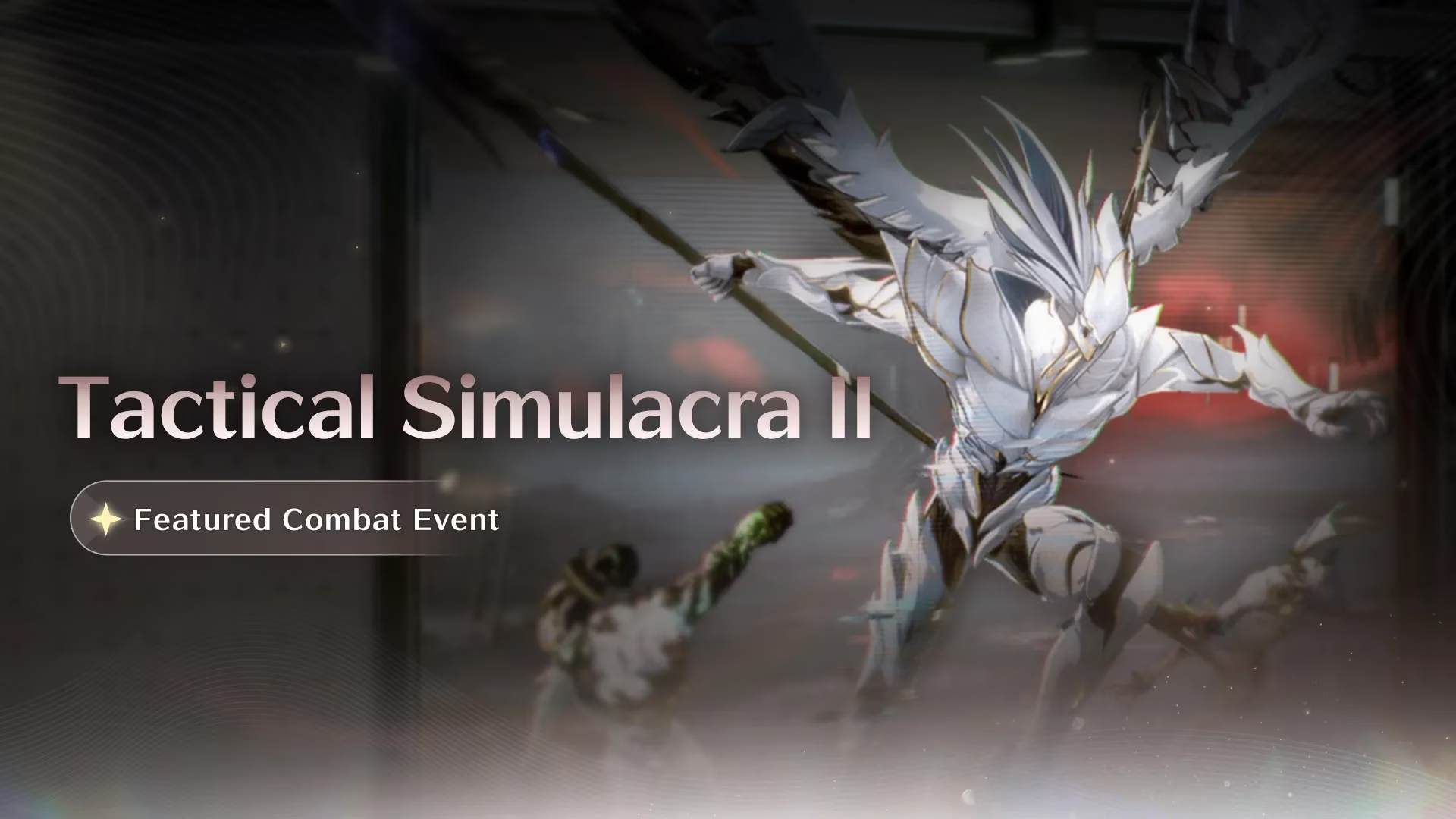
The core of the challenge lies in its multi-stage gauntlet. Seven distinct simulation domains unlock sequentially, each gated behind a 1,000-point threshold from its predecessor. As participants climb higher, the trials metamorphose from manageable skirmishes into marathon confrontations against multiple boss-level threats. It is akin to ascending a spiral staircase in the heart of a maelstrom, where every completed revolution brings fiercer winds and the promise of greater power. With escalating difficulty comes a critical lifeline: a growing arsenal of special buffs. These temporary augmentations act like a physician’s tailored serum, selectively boosting specific offensive or defensive attributes for just long enough to turn the tide of a seemingly unwinnable battle.
To enter this simulated onslaught, one must have reached Union Level 14, a baseline testament to a wanderer’s foundational journey. The rewards, however, are far from basic. Successfully carving through the required score thresholds yields a treasure trove designed to sharpen any combatant: 600 Astrite, Malleable Elite Class Echoes of both the I and II variety, a dozen Premium Enclosure Tanks, a full hundred Premium Tuners, and 860,000 Shell Credits, supplemented by a spread of valuable enhancement materials. These are not mere trinkets; they are the raw components needed to elevate resonance and refine the very weapons that will face the next, inevitable simulation.

Scoring is a three-pronged measurement of a warrior’s grace under fire. Monster Points reward raw elimination efficiency, while Time Points punish hesitation and reward decisive, swift clears. Technical Points, however, are the true differentiators, capturing the elegance of perfect dodges and the punishing rhythm of well-timed counters. This scoring trio ensures that brute force alone cannot conquer the summit; a wanderer must move as if their body is a finely tuned barometer, its reading fluctuating with every successful parry or clumsy blow absorbed.
The Combat Rank system is this very barometer made visible. Landing blows steadily nudges the gauge upward, but executing a narrow Dodge, a punishing Dodge Counter, or a risky Counterattack causes it to surge like a tide unleashed. Conversely, absorbing a direct hit sends the rank plummeting, as if the warrior’s very momentum were a sandcastle devoured by a sudden wave. Managing this delicate balance becomes especially crucial in stages where bosses arrive in packs, forcing a continuous, high-wire performance where a single misstep can cascade into a score-shattering descent.

In the 2026 season, the Academy has refined the simulation parameters, introducing more erratic enemy attack patterns and domain-specific environmental pressures. The choice of buffs before each stage now requires more strategic foresight than ever. Do you fortify your resonance to withstand an onslaught of rabid echoes, or do you inject a volatile damage booster, gambling on a perfect run where you never take a hit? This is the tactical layer that elevates the mode beyond a simple brawl. It is a puzzle box made of claws and coded fury, where the solution is written in the language of split-second reaction and loadout synergy.
The seven stages do not simply scale linearly; they mutate in thematic tone. Later domains might trap wanderers in a loop of energy-draining fields while demanding they dismantle shielded juggernauts, forcing a complete reshuffling of a team’s rotation. Players have noted that the final stage often feels less like a test and more like conducting an orchestra of chaos, where every note must land precisely or the entire symphony collapses into a discordant, fatal mess. It is in these moments that the true intent of the technology shines: not just to simulate enemies, but to simulate the crushing psychological weight of impossible odds, and then to offer a path through it.
For those who dare, Tactical Simulacra II remains one of the most demanding yet rewarding crucibles available. It is where the Academy’s rumored technology—originally whispered about in researchers’ quiet corridors—manifests as a roaring, glitching arena of growth. The rewards are tangible, but the true prize is the tempered nerve, the honed reflex, and the unshakeable knowledge that when the real, un-simulated threats emerge from beyond the horizon, you have already fought them a thousand times and won.
0 Comments